



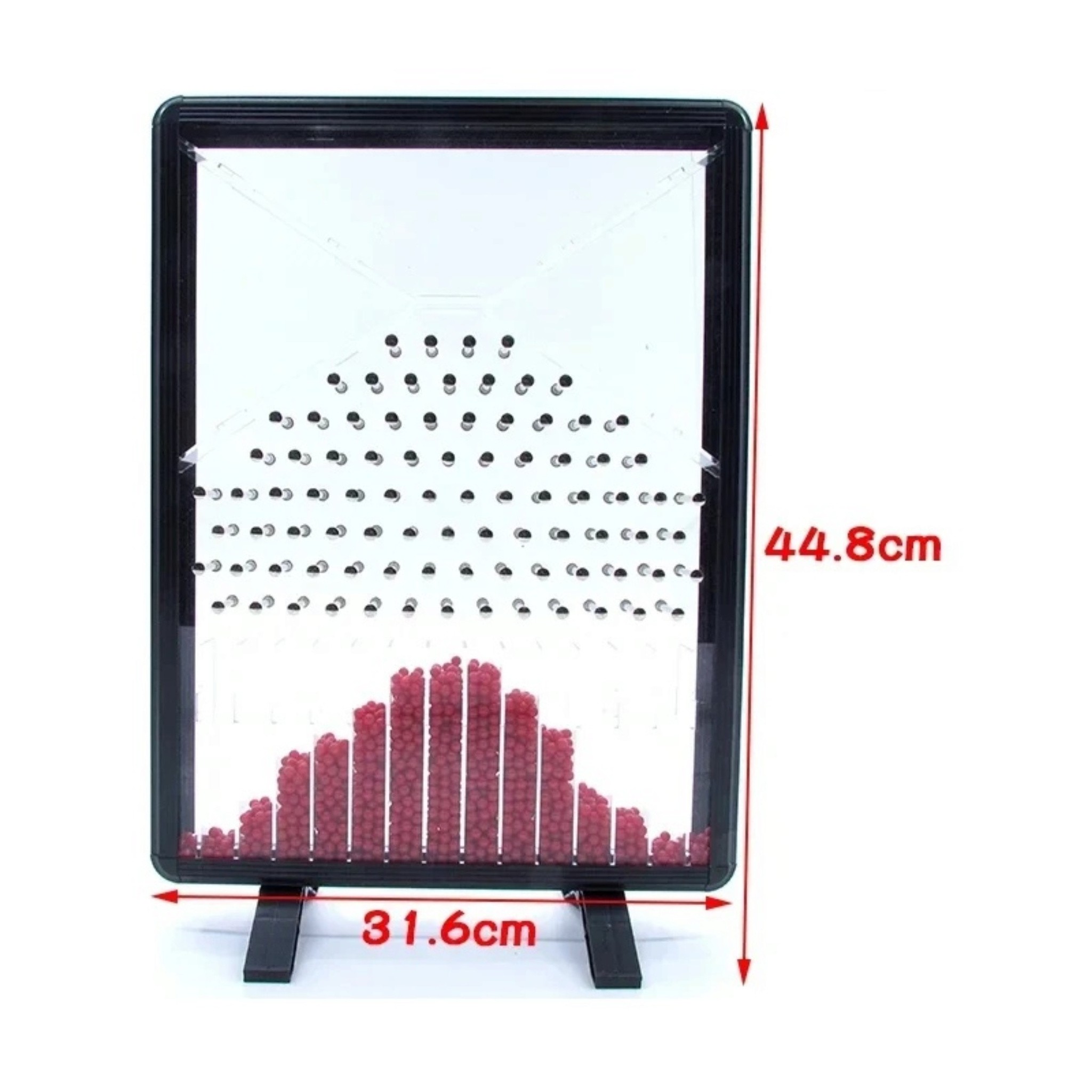
Galton Board 31.6 x 44.8 cm Model of Random Events and Normal Distribution Black Plastic Frame Red Balls Teaching Aid for Physics
You already have the maximum available quantity in your cart.

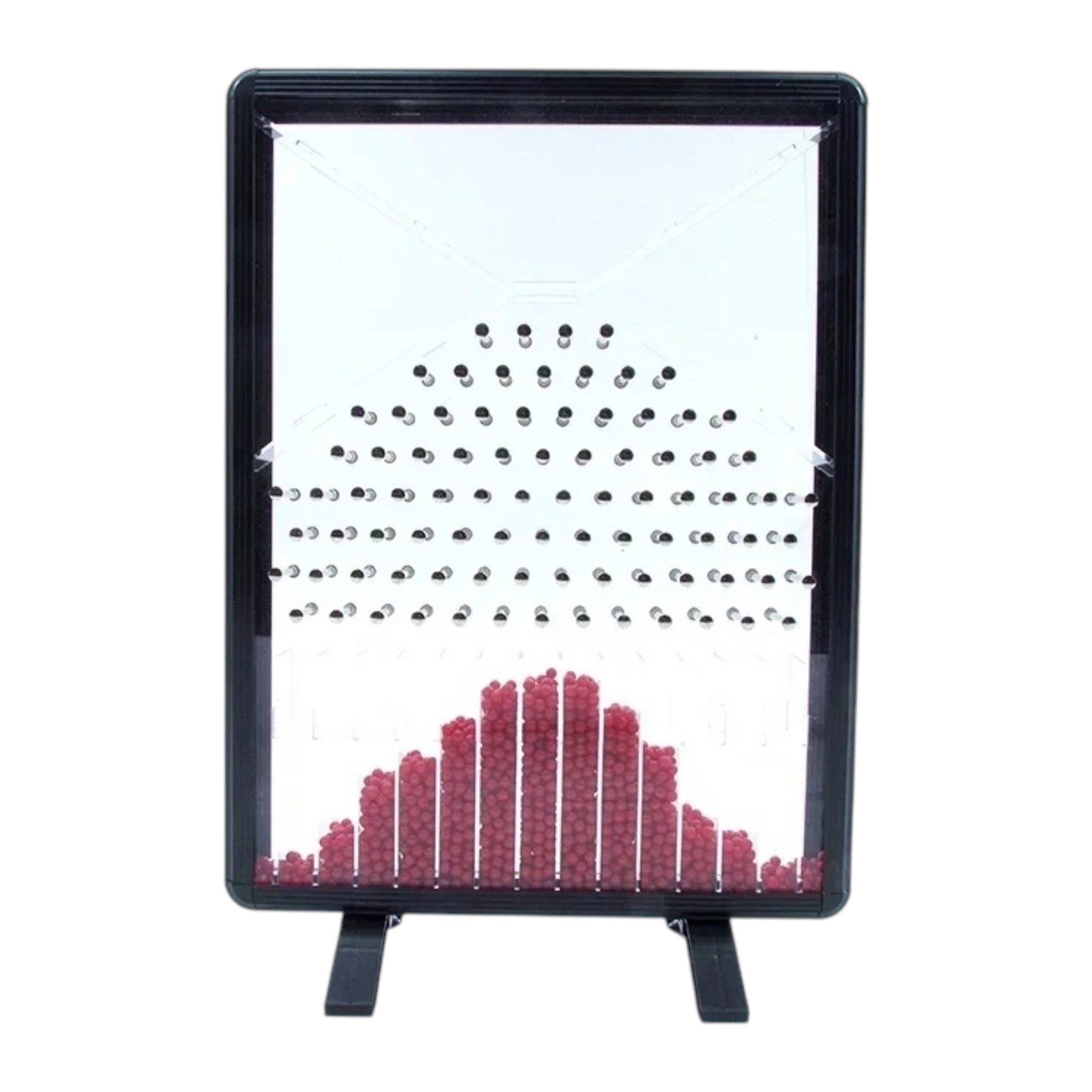
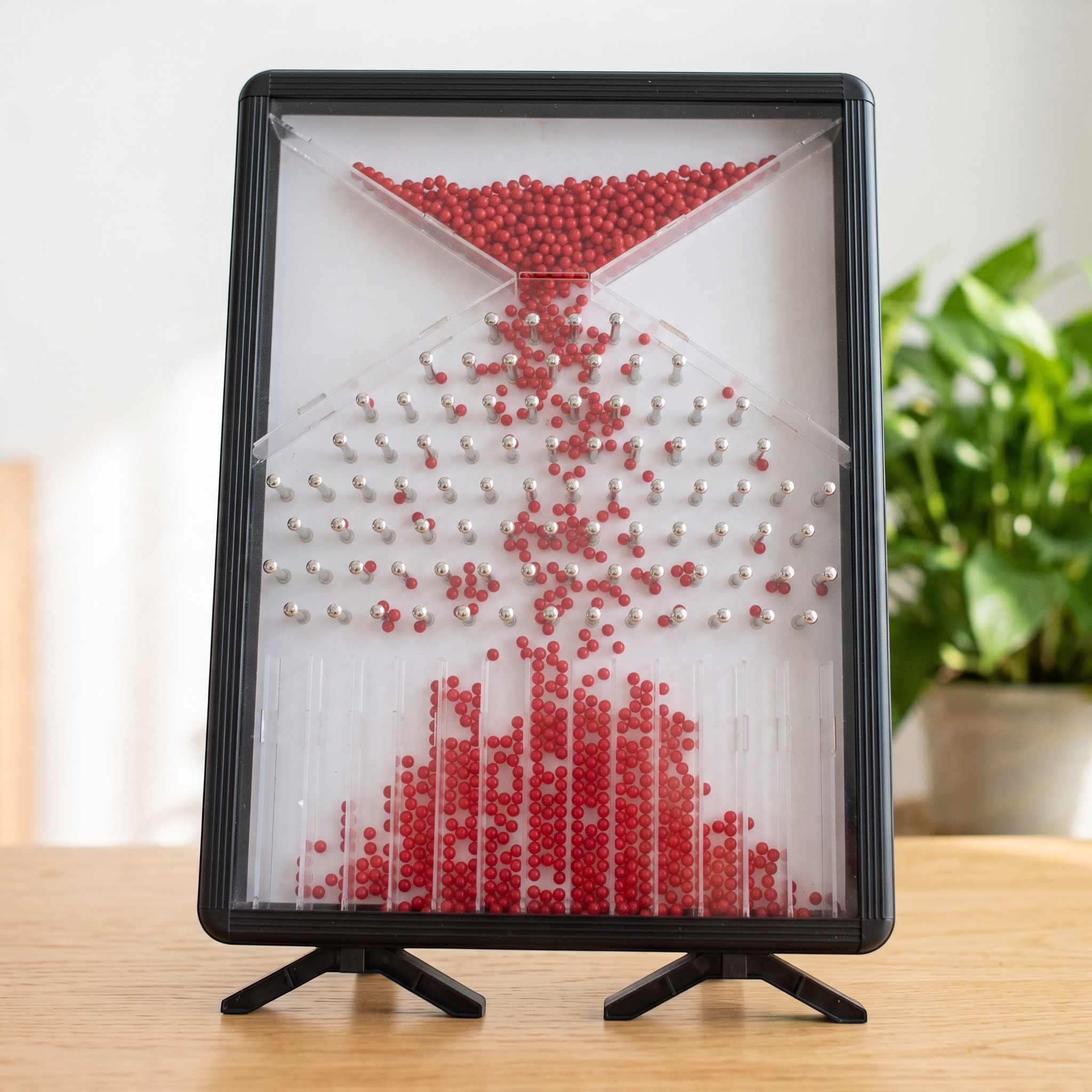
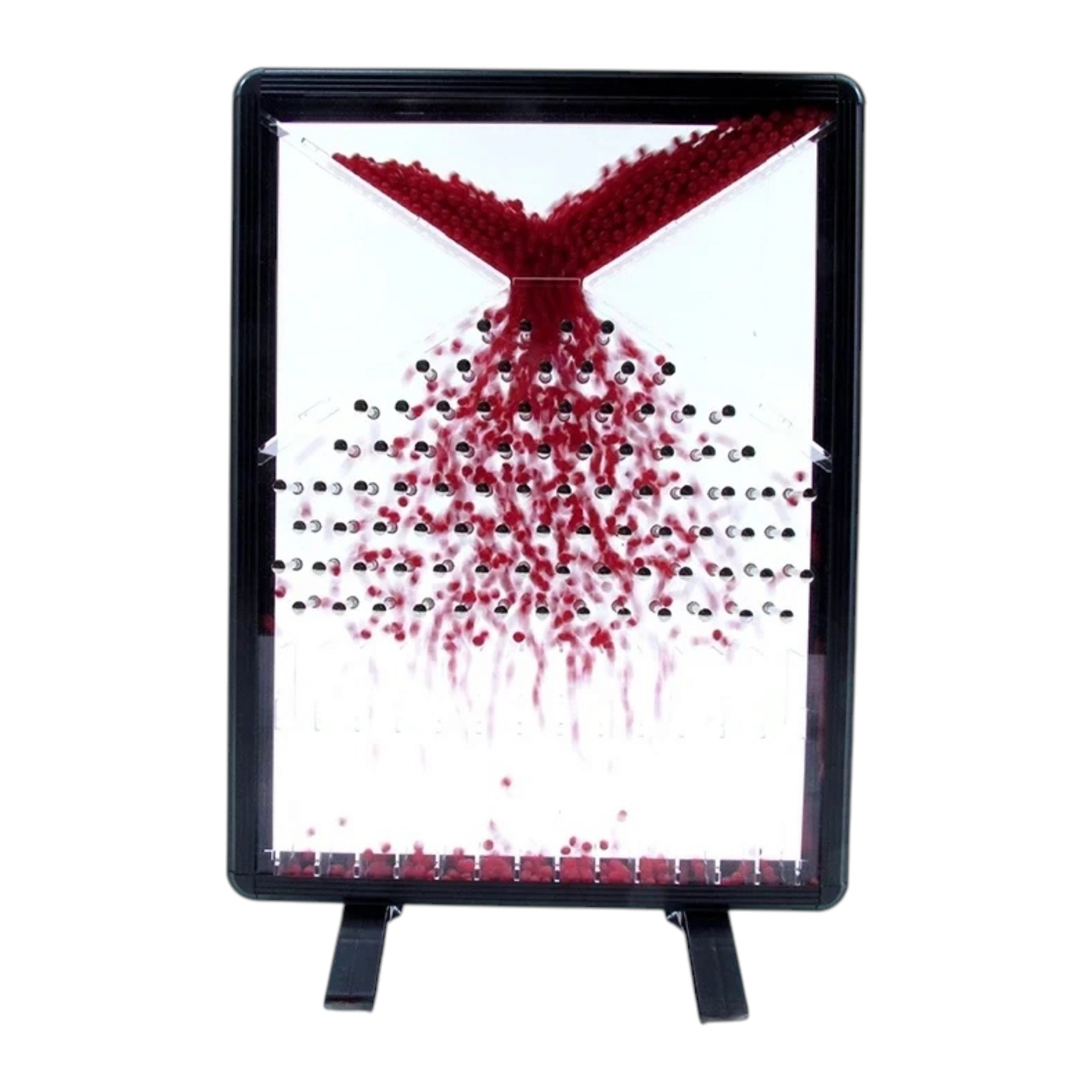
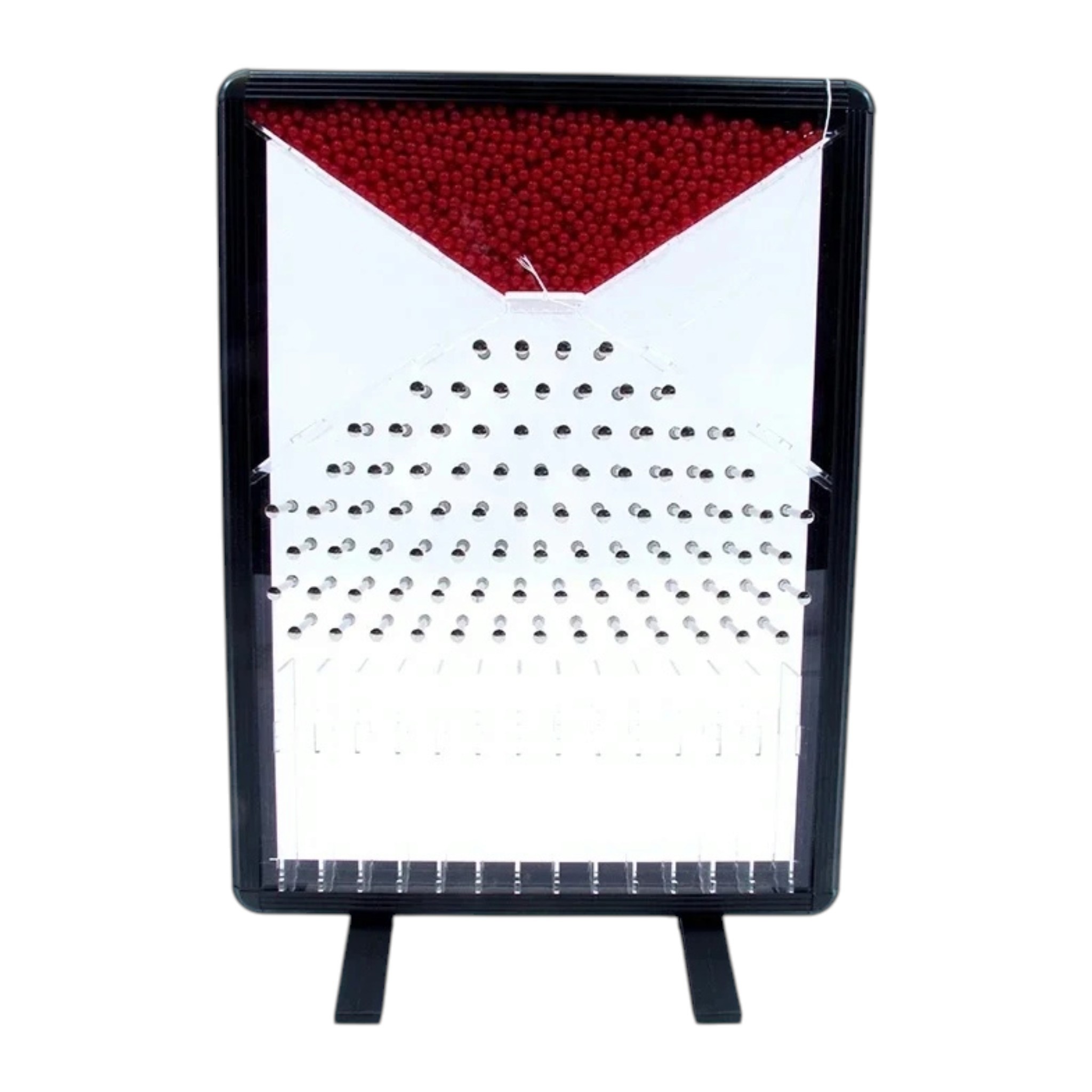
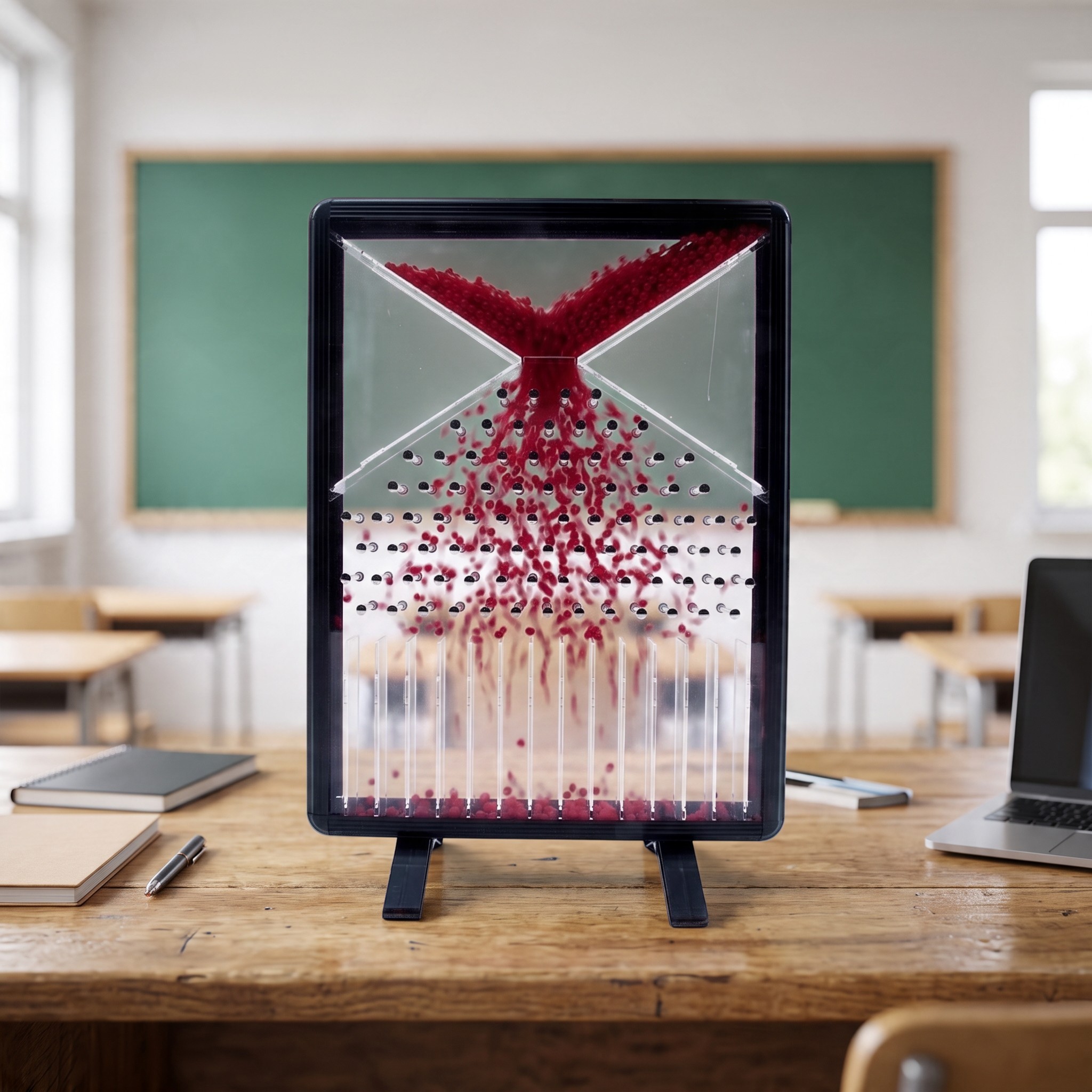
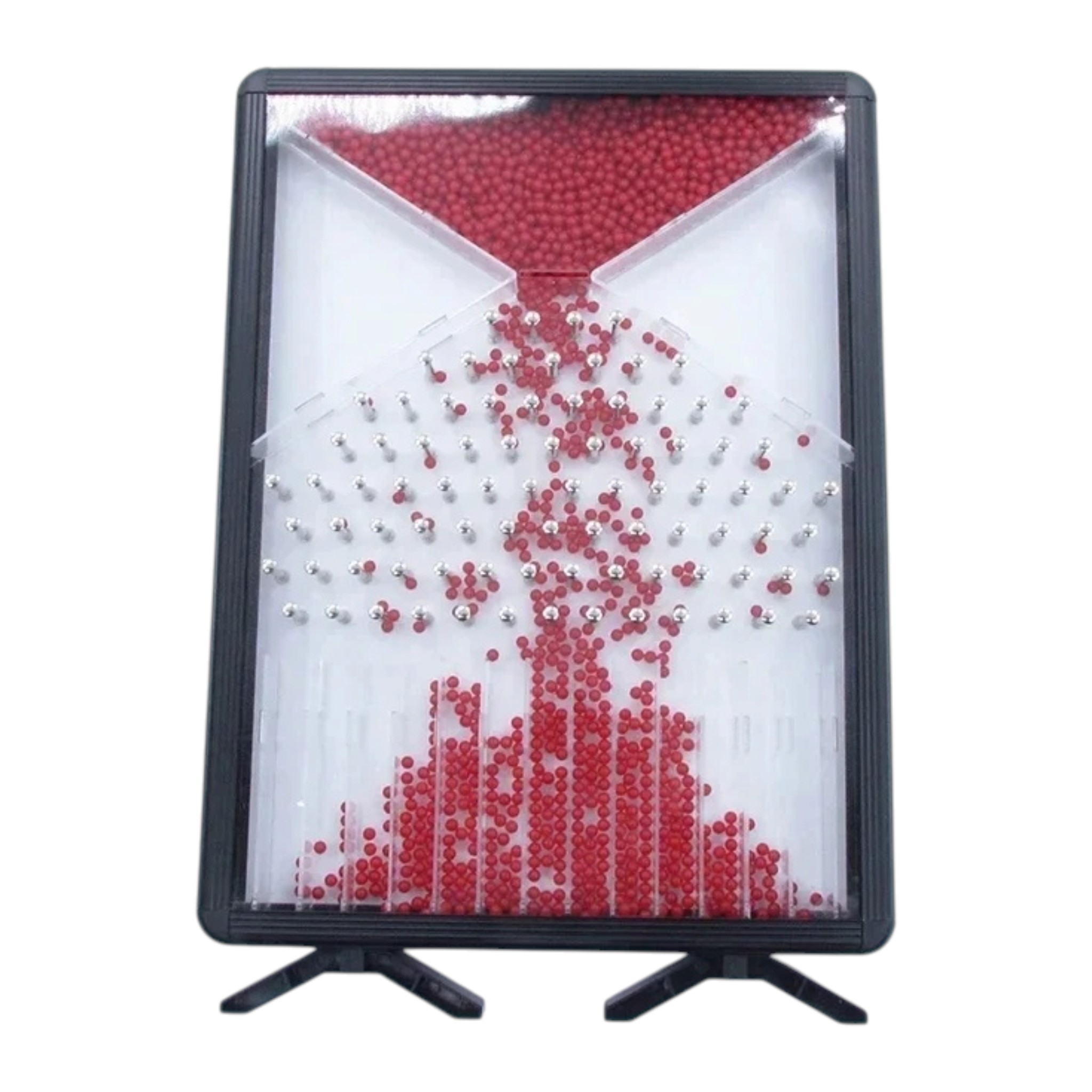
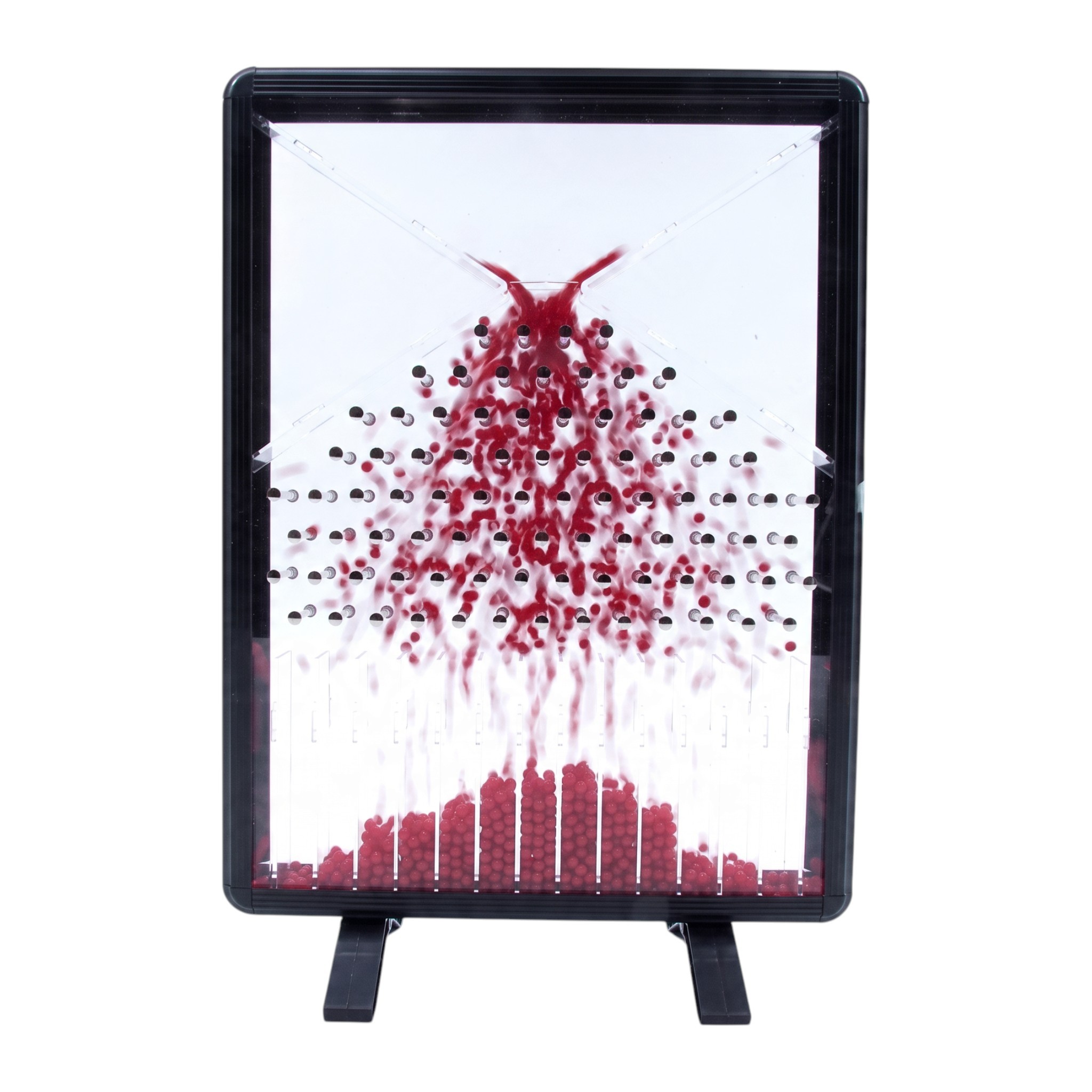
The Galton board, also known as the Dalton board, is a classic demonstration tool that clearly shows how a regular outcome is composed of many random events. This model measures 31.6 x 44.8 cm, making it suitable for demonstrations in front of the entire class. Inside the transparent body, there is a field of pegs arranged in regular rows, with a V-shaped hopper at the top and a row of narrow compartments at the bottom. When the balls are released, they collide with the pegs, scattering randomly and gradually forming a normal distribution curve in the compartments. The board thus connects the theory of probability with what students can see with their own eyes.
This tool is used to explain random events in physics and to illustrate the statistical distribution of gas molecule speeds. The pegs are spaced at equal distances both horizontally and vertically, and each peg is positioned exactly in the middle between two pegs in the row above it. A ball that hits a peg will therefore bounce left or right with a probability of 1/2 and continue to the next row. When a large number of identical balls fall, they create a bell shape at the bottom, which is highest in the middle, decreases towards the edges, and is symmetrical about the centre. This simple experiment can demonstrate why the results of many repetitions cluster around the mean and why extreme values are rare.
- Type – Galton board or Dalton board for demonstrating random events
- Dimensions – 31.6 x 44.8 cm
- Material – plastic (acrylic)
- Construction – field of pegs in regular rows, V-shaped hopper, sliding divider, and narrow compartments at the bottom
- Finish – black frame with transparent front and back sides and red balls
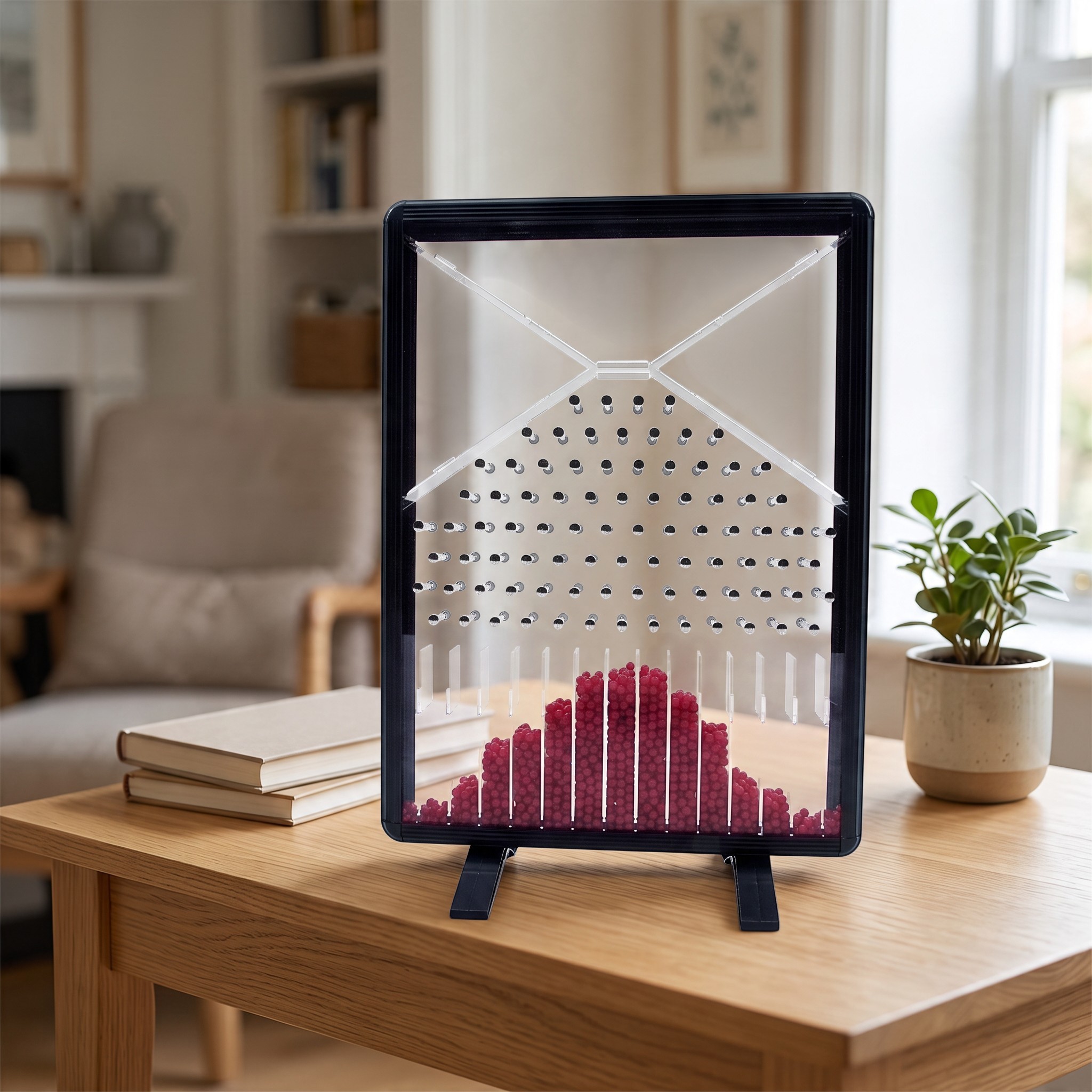
- Stand – the board stands upright on a table thanks to a pair of feet
- Usage – teaching physics and mathematics, demonstrating probability and normal distribution
- Contents – Galton board in a frame with red balls and a stand
The procedure is simple. Turn the board upside down so that all the balls collect in the V-shaped hopper, and insert the divider. Then turn the board back so that the hopper is on top, and pull out the divider. The balls will start to fall between the pegs, and the characteristic curve will gradually appear in the compartments. You can repeat the experiment as often as you like and compare how the results vary slightly with each release. The model is made of acrylic, so handle it carefully, protect it from impacts, and store it in a cool, dry place after use.
This large version of the Galton board is a practical tool for teachers of physics, mathematics, and statistics who want to visually demonstrate abstract concepts. The striking contrast of red balls against the black frame helps to track the movement of the balls even from a distance. It can be used in schools, in science clubs, or at home for joint exploration of the laws of chance. The size of 31.6 x 44.8 cm and the stable stand make it easy to place on a desk, table, or in a display case in a collection of physics teaching aids. This illustrative experiment, which can be repeated at any time, helps students understand how randomness works in physics and everyday life.
Delivery
Delivery to address€1.59
Estimated delivery: 16 – 27 November
Shipped from China
You only pay for delivery once per order, whatever its size.
We will email you the tracking number as soon as the seller makes it available.
Delivery is only possible to addresses in Ireland.
Customs and import VAT: if the goods in a parcel are worth up to €150, customs duty and import VAT are already included in the price. If the value is over €150, the carrier will charge you import VAT on delivery and, where applicable, customs duty and a customs clearance fee. Send us the receipt – we will reimburse you the full amount. You can find more information in our Terms and Conditions.
Need more information? Read our article Delivery and Payment.
Returns and Exchanges
Shop with confidence – LUNZO guarantees that your purchase goes smoothly. You arrange returns and exchanges directly with us, so there is nothing to sort out with the seller.
Returns30 days to return without giving a reason
Withdrawal period30 days from receipt of the goods
Deadline to send the goods backWithin 14 days of withdrawing from the contract
Return shipping costsYou pay the postage for sending the goods back to Spain. With An Post (Standard Post), returning a parcel of up to 2 kg to Spain costs about €30. We charge no other fee.
RefundWithin 14 days of your notice of withdrawal, using the same payment method you used for the purchase. If you return the whole order, we will also refund the delivery cost.
Crediting of the amountUsually 2–10 working days, depending on the payment method
Product conditionYou may unpack the goods and try them as you would in a shop, and you can return them even without the original packaging
Returns addressQX-BOX AEMALL RETURN
Rotonda Rene Descartes, Parcela 101 – Nave 3
28070 Alcala de Henares, Madrid
SpainReturns centre in Spain operated by Qxbox, an e-commerce logistics provider and logistics partner of the sellers on our platform.
How do I return goods?
- Email us at info@lunzo.ie with your order number and the items you are returning.
- Pack the goods and send them by post to the returns address in Spain.
- Send us the proof of dispatch with the tracking number – this lets us refund you without waiting for the parcel to arrive.
Faulty goodsUp to 6 years to claim for faulty goods
Did the goods arrive damaged, do they not work, is something missing from the parcel or do they not match the description? We will sort it out.
Period for claiming a faultUp to six years from delivery of the goods
RefundWithout undue delay once the claim has been settled, using the same payment method you used for the purchase
How does it work?
- Email us at info@lunzo.ie with your order number and a description of the problem, and attach photographs or a video.
- We will assess it and suggest a solution. Photographs are usually enough – please do not send the goods back until you have received instructions from us.
- We will settle your claim within 30 days at the latest – with a new item, a price reduction or a refund.
If the goods need to be sent back, we will refund the postage for a valid claim (just provide the receipt).
ExchangesA different size, colour or variant
Write to us within 30 days of receipt at info@lunzo.ie with your order number and the variant you are interested in. We usually reply within 24 hours.
If the variant is available, we will send you instructions for the exchange. You pay the cost of sending the original item back; the new variant will be sent to you at no further charge.
Need more information? Read our articles Returns and Exchanges and Faulty Goods.
Payment methods
 Credit / debit card
Pay with your Visa or Mastercard through a secure payment gateway. Payment goes through instantly, so we can process your order straight away.
 Apple Pay
Pay with a card saved in Apple Wallet on your iPhone, iPad or Mac. You confirm the payment with Face ID, Touch ID or your passcode.
 Google Pay
Pay with a card saved in your Google account, on an Android phone or in the Chrome browser. You never have to enter your card number.
 Bank transfer
Once you complete your order, we will send you the details for the bank transfer. Your order will be dispatched as soon as the payment reaches our account.
 Revolut Pay
Pay with your Revolut account – simply confirm the payment in the Revolut app, without entering any card details. Payment goes through instantly.
Payment is made through a secure payment gateway and your card details are never stored anywhere on our side. We do not charge a fee for any payment method.
Need more information? Read our article Delivery and Payment.
About the seller
This product is sold and shipped by an external seller. LUNZO guarantees you a safe purchase: online payments go through a secure payment gateway, and you handle your order, returns and complaints with us.
The following information has been provided by the product seller, who is responsible for its accuracy. The seller acts as a trader.
Seller:
Gansu Constar Technology Group Co., Ltd.
Address: No.10, Chuangxin South Road, Baiyun District, Baiyun, Gansu, China
E-mail: ksdjt@foxmail.com
Telephone: +86 156 9392 3686
Manufacturer:
Gansu Constar Technology Group Co., Ltd.
Address: No.10, Chuangxin South Road, Baiyun District, Baiyun, Gansu, China
E-mail: ksdjt@foxmail.com
Telephone: +86 156 9392 3686
EU responsible person:
BioDomi GmbH
Address: Schokoladenring 13, 65795 Hattersheim am Main, Germany
E-mail: arcontact@biodomieurope.de
Telephone: +49 178 5749814
All products from this seller