
















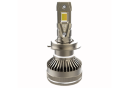













Xenon car bulbs
Instead of a glowing filament, a xenon bulb produces light with an electric arc between two electrodes inside a glass capsule filled with xenon gas. It gives roughly twice the luminous flux of a halogen bulb while drawing only about 35 W. Types differ in base, such as D1S, D2S, D3S or D4S, in colour temperature and in whether the igniter is built into the base. A replacement is chosen according to the type fitted to the car at the factory.
Xenon car bulbs
To start, the bulb needs an igniter, which strikes the arc with a short pulse of over 20,000 V, and a ballast, which then maintains a stable operating voltage. The bulb only reaches full brightness after a few seconds, which is why xenon is mainly used for dipped beam. In bi-xenon headlights, main beam is produced by a moving shutter that releases the full beam. As there is no filament, the bulb copes better with vibration and usually lasts several thousand hours.
The base designation indicates how the bulb is built. The letter S stands for bulbs used in projector headlights with a lens, while R is for reflector headlights, where a dark strip on the glass creates the beam cut-off. Types D1 and D3 have the igniter integrated in the base, whereas D2 and D4 connect to a separate igniter. D3 and D4 bulbs are mercury-free and run at a lower voltage, so they cannot be swapped with D1 and D2. You can find the type on the old bulb or on the headlight label.
Factory bulbs usually have a colour temperature of around 4300 K, which gives white light with a slightly warm tone and lights up the road well even in rain. Replacements rated 5000 to 6000 K give a cooler white, higher values already look bluish, and luminous flux falls as colour temperature rises. Both bulbs in the car should have the same colour temperature, otherwise the difference is obvious at a glance.
Over time, xenon bulbs lose brightness and their light shifts towards violet, so it is best to replace them in pairs. Before replacing them, switch off the lights and ignition, as the ballast operates at high voltage, and let the bulb cool. Do not touch the glass with your fingers. If the light flickers or cuts out, the fault may lie in the bulb, but also in the ballast or igniter.
Xenon bulbs belong only in headlights that are approved for xenon from the factory. Such cars usually also have headlight washers and automatic headlight levelling so the light does not dazzle. Fitting a xenon kit into a halogen headlight is not road legal, because its optics are not designed for a discharge lamp. Bulbs marked with an E are intended as replacements in original xenon headlights.