

























































































































TV brackets and stands
A wall bracket frees up space on the TV unit and puts the screen at a comfortable viewing height. TV brackets and stands differ mainly in design and load capacity: fixed brackets hold the TV close to the wall, tilting and swivel models let you adjust the angle, and floor stands are useful where you cannot drill into the wall or need to move the TV. What always matters is the VESA hole pattern and the weight of the TV.




TV brackets and stands
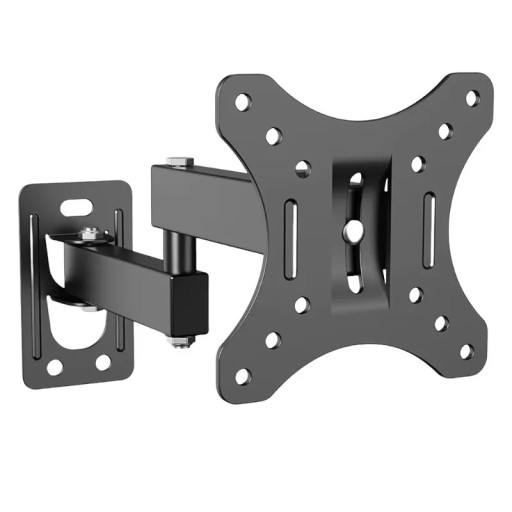
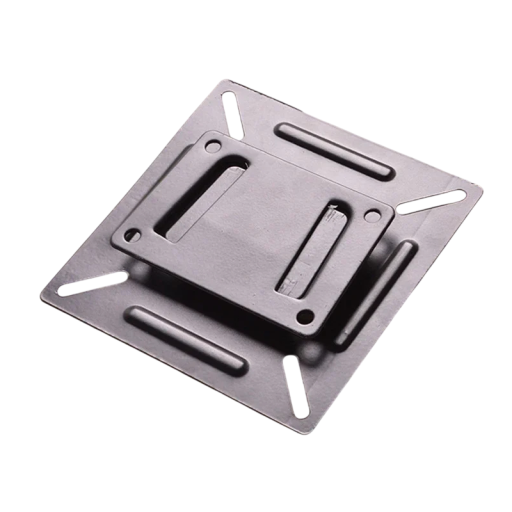
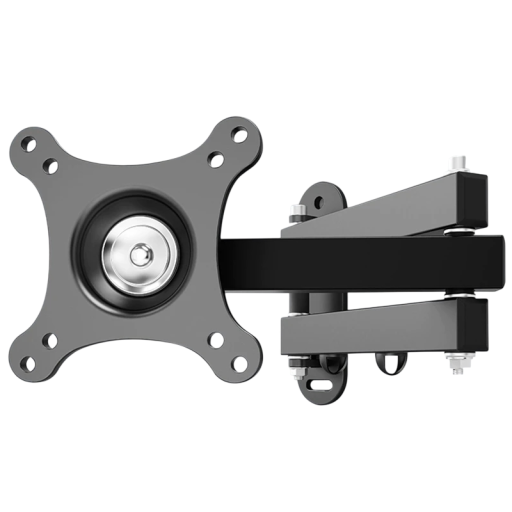
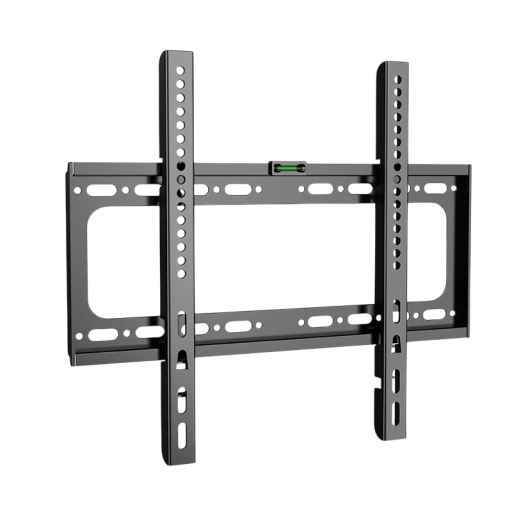
The simplest are fixed brackets, which hold the TV just a few centimetres from the wall and suit rooms where you watch straight on. Tilting brackets let you angle the screen downwards, which helps when mounting above a fireplace or chest of drawers. A full-motion arm with joints lets you pull the TV away from the wall and swivel it towards the sofa, the dining table or a corner of the room. Ceiling mounts are used mainly in offices, waiting rooms and attic rooms.
The bracket must match the VESA pattern, meaning the spacing of the threaded holes on the back of the TV. Smaller sets usually have 100 × 100 or 200 × 200 mm, large TVs 400 × 400 mm or more. You will find it in the manual or on the back cover itself. Just as important is the load capacity: the TV's weight should be below the maximum stated by the bracket manufacturer, with some margin for full-motion arms, because leverage puts extra strain on the fixings when the arm is extended. The screen size range on the box is only a guide.
Fixing depends on the wall. Good plugs are enough in concrete and solid brick, while hollow blocks need longer plugs designed for hollow materials. In plasterboard you need to fix into the studs or use special cavity anchors, and even then it only suits lighter TVs. The centre of the screen should be roughly at the eye level of a seated viewer, usually about a metre above the floor.
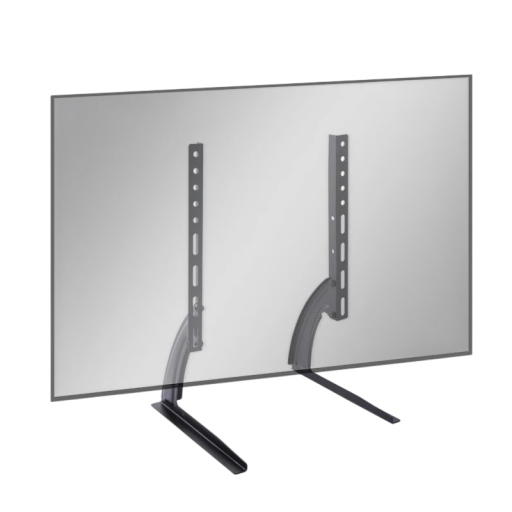
Where drilling is not an option, floor stands with a column are the answer; the TV screws onto them just as it would onto a bracket. Versions on wheels are used in offices and schools, while living-room stands often hide the cables inside the column. Tabletop stands with a swivel base replace the original feet and let you turn the TV without moving the whole unit.
When fitting TV brackets and stands for a large TV, have a helper and a spirit level to hand; on most brackets a slight tilt can still be corrected after hanging. Also allow room for the connectors: if the HDMI inputs point straight back, spacers or a bracket with a greater wall distance will help. Cables can be hidden in trunking or inside the wall. If the TV stands on furniture in a home with children, secure it against tipping with a strap anchored to the wall.