



































































Saw stands and guide rails
A stand and a guide rail do not cut anything themselves, but they decide whether the cut comes out straight. Rail length has to run fifteen to twenty centimetres past the cut at both ends, and longer pieces are joined with a connector. The splinter-guard edge is trimmed to the width of the blade on the first pass and from then on sits straight on the marked line. The stand is set so the saw table stands at waist height, and roller supports go a little below it.
Saw stands and guide rails
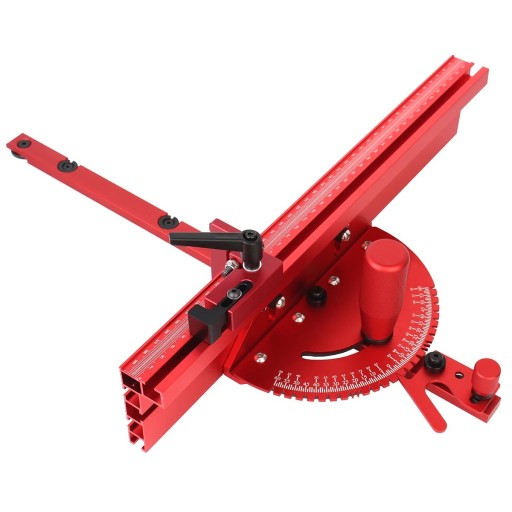
A stand and a guide rail do not cut anything themselves, but they decide whether the cut comes out straight. The rail keeps the saw on line instead of a pencil mark and turns a hand-held circular saw into a tool for cutting sheet goods to size. The stand lifts a table or mitre saw to working height and supports material that would otherwise hang over the edge. Both pay off above all for anyone cutting long pieces alone, without a second person to hold them.
Rail length sets what can be cut with it, because it has to run past the cut at both ends. A 600 mm rail is enough for cross cuts in battens and narrower boards, sheet goods call for 1400 mm. The saw needs fifteen to twenty centimetres of run-up at the start and at the end, or it does not enter the cut straight. Longer pieces are handled by a connector that joins two rails into one and keeps them in a single line.
Along the edge of the rail runs a splinter-guard lip of rubber or plastic, which the first cut trims exactly to the width of the blade. From then on it is enough to lay that edge on the marked line and the cut falls precisely where it should. The underside carries anti-slip strips, but on shorter pieces the rail is still secured with clamps in the slot. Not every saw fits every rail, and hand-held circular saws need an adapter or a universal base plate.
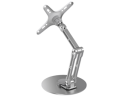
On the stand the adjustable height is what counts, because the saw's work table should sit at roughly waist height. A range from thirty-eight to a hundred and forty centimetres covers working seated as well as standing, and in the low positions the stand serves as a support. Folding legs have to lock, or the stand collapses under load. Load capacity is quoted in kilograms and refers to evenly distributed material, not to a point load.
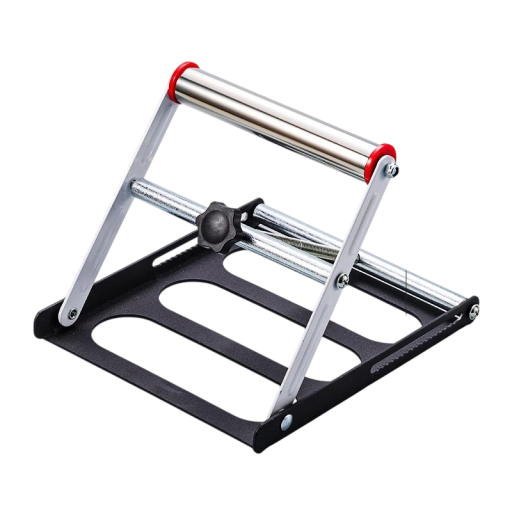
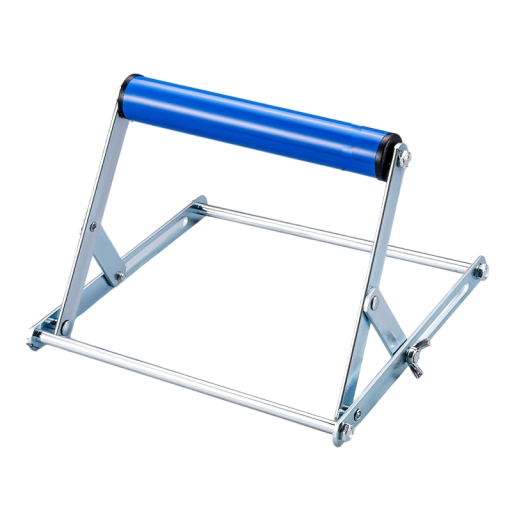
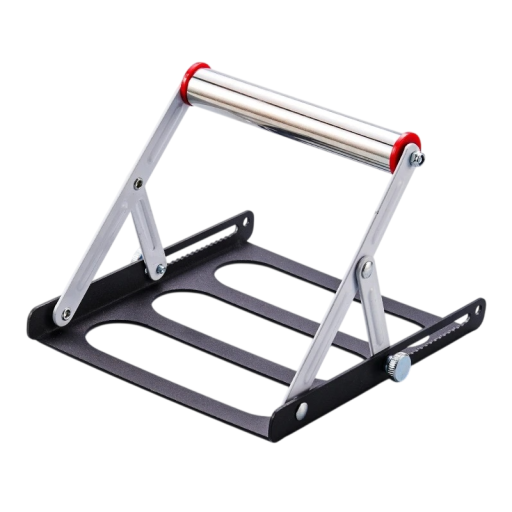
Long pieces are carried by roller supports, set both behind and in front of the saw. The rollers are set a little below the saw table, never above it, or the material lifts in the cut and the blade binds. Two stands around the saw turn a single machine into a small workshop line where the board never has to be lifted.