







































































































































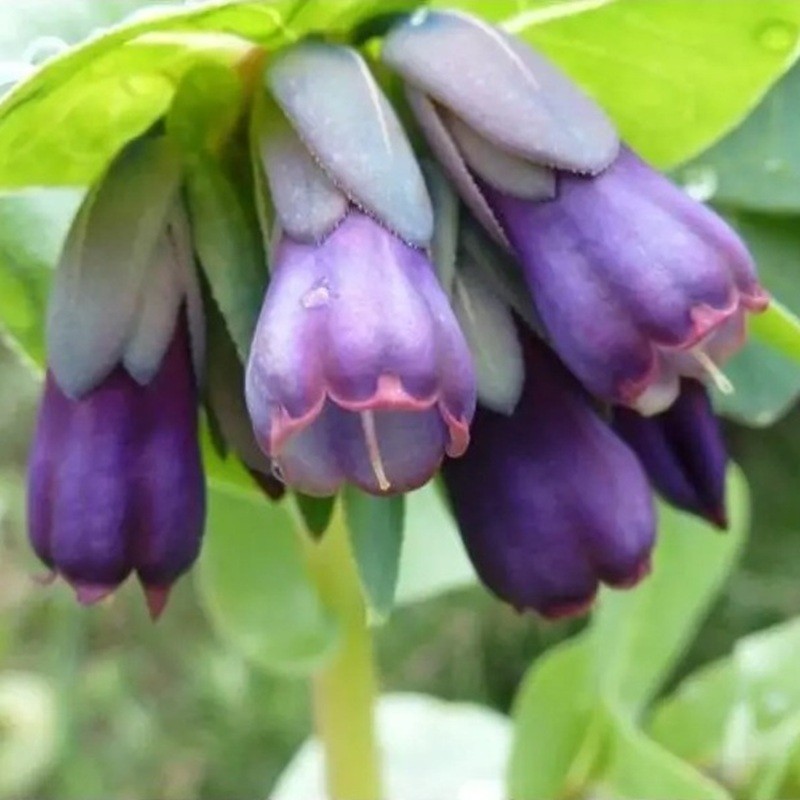
Larger Honeywort Cerinthe major 20 Seeds Summer Annual with Purple-Blue Flowers for Garden, Planter and Dried Bouquets
You already have the maximum available quantity in your cart.

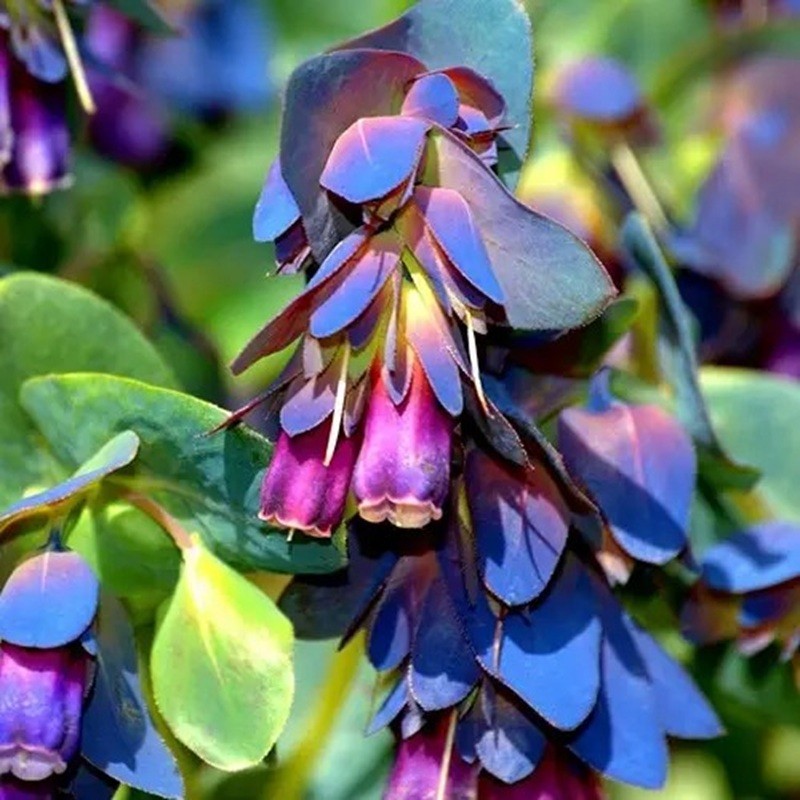
Cerinthe major, larger honeywort, represents a gem among ornamental annuals for gardeners who appreciate unusual plants with an extraordinary colour palette. This pack contains 20 seeds for extended planting or repeated sowing throughout the season. The species originates from sandy and stony habitats in Southern Europe and Northern Africa, where it grows on sunny slopes and field edges. The plant is favoured by florists due to its characteristic bract leaves, which transition from blue-green to purple and then to burgundy.
When planting, honeywort thrives when sown directly into permanent positions, where it has enough space for root system development. The seeds have a harder shell, so a short soak in lukewarm water for 6 to 12 hours is advisable before sowing. They will germinate within two to three weeks, ideally at temperatures around 16 to 20 °C. A spacing of approximately 25 to 30 cm between plants is recommended to allow for the free spread of lateral stems. It prefers lighter, sandy soil with a neutral to slightly alkaline pH and a sunny position.
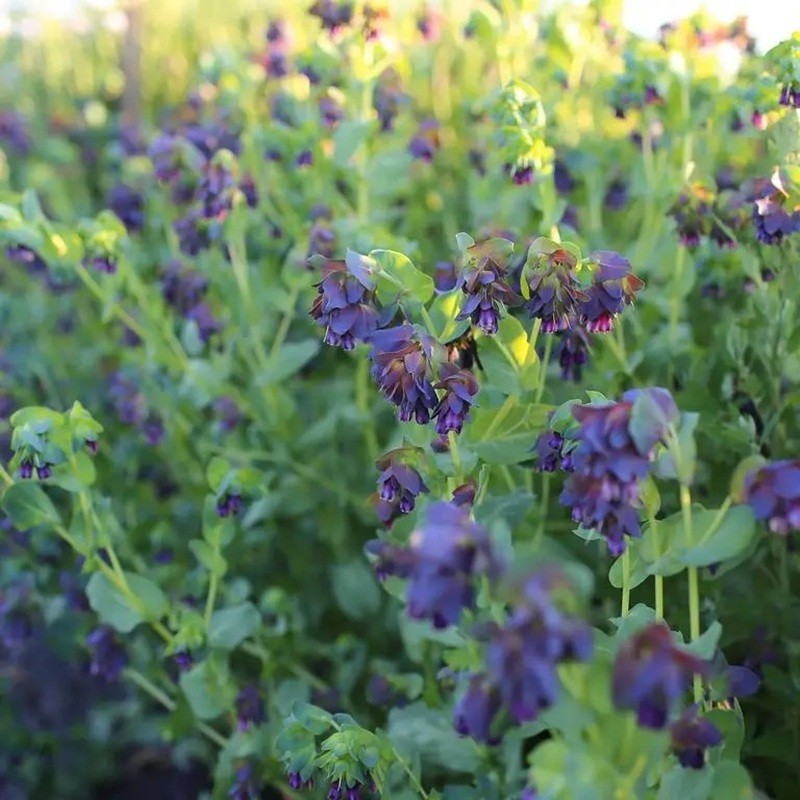
Honeywort in full bloom captivates not only with its colour but also with the structure of the plant – from soft stems, upright branches with embracing leaves and hanging clusters of tubular calyces emerge. The species is among excellent nectar-producing plants, whose flowers are mainly visited by large bee species and bumblebees. After flowering, round seed capsules form in the bracts, from which seeds mature for further cultivation. If several flowering stems are allowed to mature, the plant often self-seeds in the garden in subsequent seasons.
Main characteristics:
- Botanical species: Cerinthe major, larger honeywort
- Habit: upright compact annual
- Plant height: 30–60 cm
- Leaves: fleshy, blue-green, embracing
- Bracts: changing colours (blue, purple, burgundy)
- Flowers: tubular, hanging, blue to purple
- Flowering period: summer to early autumn
- Position: sunny, well-drained lighter soil
- Cultivation: flower bed, pot, planter, cut flowers
- Sowing: late April to May, direct
- Seed preparation: short soak in warm water
- Germination temperature: 16–20 °C
- Germination time: 2–3 weeks
- Attractiveness: highly nectar-rich plant
- Frost resistance: annual, sensitive to frost
- Origin: Southern Europe and Northern Africa
Growing more specimens of honeywort is worthwhile if you plan to create flowering strips that support biodiversity or a larger autumn harvest of stems for cutting. The inflorescences with bracts last in water for 5 to 8 days and maintain their structure and colour transitions in drier arrangements. Larger honeywort is also suitable for wildflower beds in a rustic style, where it naturally mixes with poppies, cornflowers or dianthus. In combination with a universal substrate and well-drained conditions, the plant grows reliably both in beds and in deep containers. To improve soil quality, it is advisable to add some compost at the beginning of the season, which will help the plant create more robust clumps with richer flowering.

Seller: Largon
Dispatched within 1 working day (Mon–Fri) – orders paid for by 14:00 Irish time are processed on the same working day.
Availability: In stock
Transit: 5–13 working days – transit takes place on working days (Mon–Fri).
In total, please allow 5–14 working days from payment of your order.
Delivery is only possible to addresses in Ireland.
Delivery to address: €1.59
Returns
Deadline: 30 days from receipt of the goods, without giving any reason
How: notify us of your withdrawal at info@lunzo.ie and send the goods by post to the returns address:
Rotonda Rene Descartes, Parcela 101 – Nave 3
28070 Alcala de Henares, Madrid
Spain
Once you have sent the parcel, send us the proof of dispatch with the tracking number to info@lunzo.ie – this lets us process your return as quickly as possible and refund you without waiting for the parcel to arrive.
Product condition: you can also return goods that have been used or unpacked, or that no longer have their original packaging or tags
Costs: you pay the postage for sending the goods back to Spain; we charge no return fee
Refund: within 14 days of receiving your notice of withdrawal; we may withhold the refund until the goods have arrived back or until you provide proof that you have sent them
Exchanges
Deadline: 30 days from receiving your parcel (exchange for a different size, colour or variant)
How: write to us at info@lunzo.ie, giving your order number and the variant you want – once we have checked that it is available, we will send you instructions for the exchange, including the address to which you should send the original item
Costs: you pay to send the original item back; the new variant will be sent to you at no further charge
Faulty or damaged goods
Period for claiming a fault: up to six years from delivery of the goods – within the first 30 days you can reject a faulty product and ask for a full refund, and for the first 12 months a fault is presumed to have been present on delivery
How: write to us at info@lunzo.ie and attach a photograph or a video of the goods – in most cases you do not have to send the goods back
Remedies: a replacement with a new item, a reasonable price reduction, or a refund of the full purchase price
You will find the details in Delivery and Payment, Returns and Exchanges, Faulty Goods.
Seller:
Jinbao Tengda Mechanical Equipment (Tianjin) Co., Ltd.
Address: No.76, District 3, Zhenbei Village, Xinkou Town, Baodi District, Tianjin, China
E-mail: 728123120@qq.com
Telephone: +86 187 6653 7872
Manufacturer:
Jinbao Tengda Mechanical Equipment (Tianjin) Co., Ltd.
Address: No.76, District 3, Zhenbei Village, Xinkou Town, Baodi District, Tianjin, China
E-mail: 728123120@qq.com
Telephone: +86 187 6653 7872
EU responsible person:
MACYSAN ADVISORS SL
Address: Calle Benito Pérez Galdós, 4, 03201 Elche, Alicante, Spain
E-mail: macysanadvisors@gmail.com
Telephone: +34 653 13 94 97